What is Volcano Physics actually?
August 20, 2026
Volcanoes are geological systems, but many of the questions we ask about how they work are really questions about physics.
How does magma move through the crust? Why do some eruptions explode while others produce lava flows? How do heat, pressure, gravity, and material properties influence what happens before, during, and after an eruption?
Volcano physics uses ideas from fluid mechanics, thermodynamics, mechanics, heat transfer, and other areas of physics to understand processes like these. Mathematics, experiments, and computer models give us ways to study systems that are often too hot, too deep, too large, or too dangerous to observe directly.
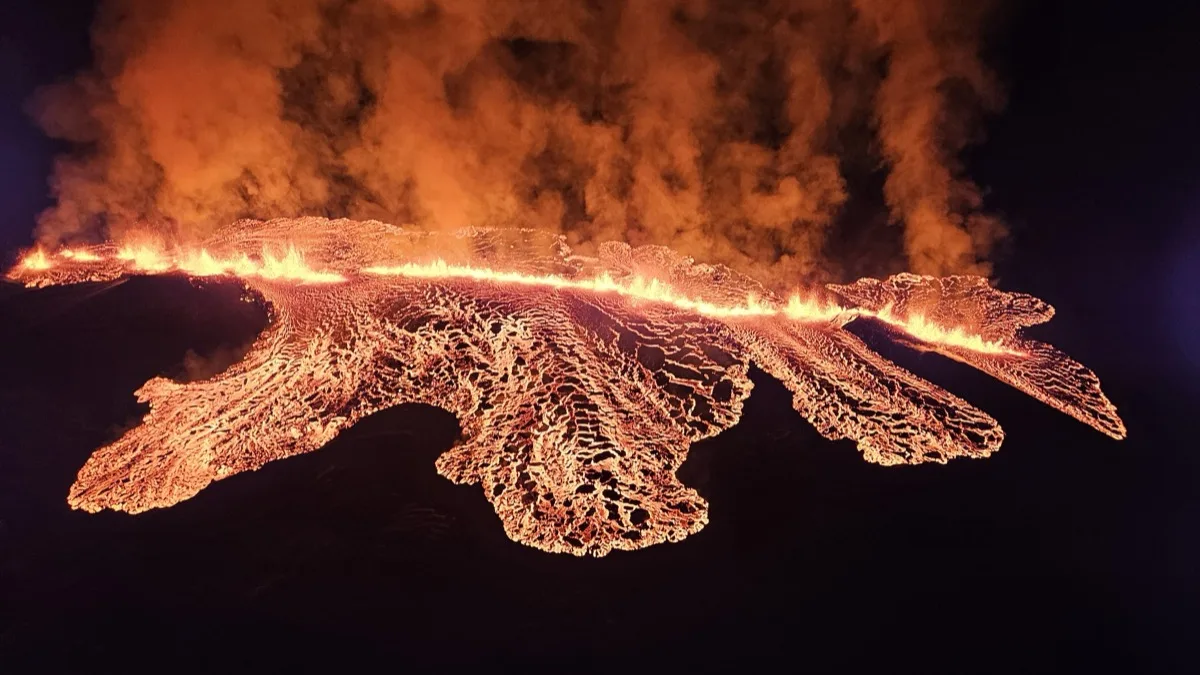
Consider a fissure eruption. It may begin as a spectacular curtain of fire, with lava erupting from many vents, but within hours or days most of that activity can shut down and become concentrated at only a few locations. What causes that change?
There may not be a single answer. Cooling can make some parts of the magma more viscous than others. Parts of the fissure can begin to solidify and close. Lava accumulating at the surface can change the pressure at individual vents. The dike feeding the eruption may also deliver different amounts of magma from place to place.
All of these processes could produce a similar pattern at the surface while relying on very different physics. That is the kind of problem volcano physics is useful for. We can take competing explanations, describe the underlying processes mathematically, and ask which ones are actually capable of producing what we observe. Some problems can be worked through with relatively simple equations, while others require computational methods to explore how the different processes interact.
That same approach can be used across volcanic systems. The goal is not just to describe what a volcano did, but to understand the physical processes that made it behave that way.
The storage and eruption of volcanic material present the problem. Volcano physics helps us investigate the processes behind it.